
Insight
Is Managing Cloud Infrastructure Taking Your Team Away from Your Product Roadmap?
By Robert Ross, Chief Technology Officer, Vela Cloud
For an established software company, delivering on your product roadmap is essential to stay competitive. Your customers expect new features, ongoing improvements, and a product that evolves with their needs.
That requires a focused development team, clear priorities, and the resources to deliver.
As more customers look for cloud-based access to the applications they rely on, independent software vendors (ISVs) face another important priority: making their software available through the cloud.
But who will manage that infrastructure?
Building and managing your own cloud environment can introduce responsibilities that compete directly with product development, pulling valuable technical expertise and management attention away from the work that drives your business forward.
The question isn't simply how to take your application to the cloud. It's how to do so without jeopardizing the product roadmap that keeps your business competitive.
What Does Managing Cloud Infrastructure Actually Involve?
Your development team understands your application. They know its architecture, dependencies, limitations, and the functionality that matters to your customers.
That doesn't necessarily mean they're equipped to operate a cloud hosting environment at scale.
Managing cloud infrastructure involves ongoing responsibilities such as performance monitoring, security, backups, disaster recovery, capacity planning, and technical support.
These aren't one-time activities that end when your first customer goes live. Security vulnerabilities need addressing, performance issues need investigating, and backup and recovery processes need testing. When something goes wrong, someone needs to respond, regardless of what else your team is working on.
For a company whose core expertise is developing software, cloud hosting is a major expansion of operational responsibility.
The Opportunity Cost of Managing Cloud Hosting In-House
One approach is to assign cloud operations responsibilities to the people you already employ.
At first, that can seem sensible. Your developers know the application, and some may have experience managing servers or infrastructure. For certain employees, it might even present a professional development opportunity.
But development capacity is finite.
Every hour a developer spends troubleshooting a hosting issue or managing infrastructure is an hour unavailable for improving the application.
A product release may be delayed. A technical improvement gets pushed into the next development cycle. A customer-requested enhancement has to wait because an unexpected infrastructure problem calls for immediate attention.
Over time, these interruptions can affect your ability to deliver on the product roadmap, respond to customer needs, and maintain your competitive position.
What ISVs most often underestimate is how different the two skill sets are. Many of the software companies we talk with are specialists: they build and maintain a Windows application for one industry, and that deep knowledge of their vertical is exactly what their customers pay for. Setting up and running cloud hosting draws on a completely different set of skills and knowledge. Learning it, and then keeping up with it, becomes a distraction from the core work of building an application that delivers value to their industry.
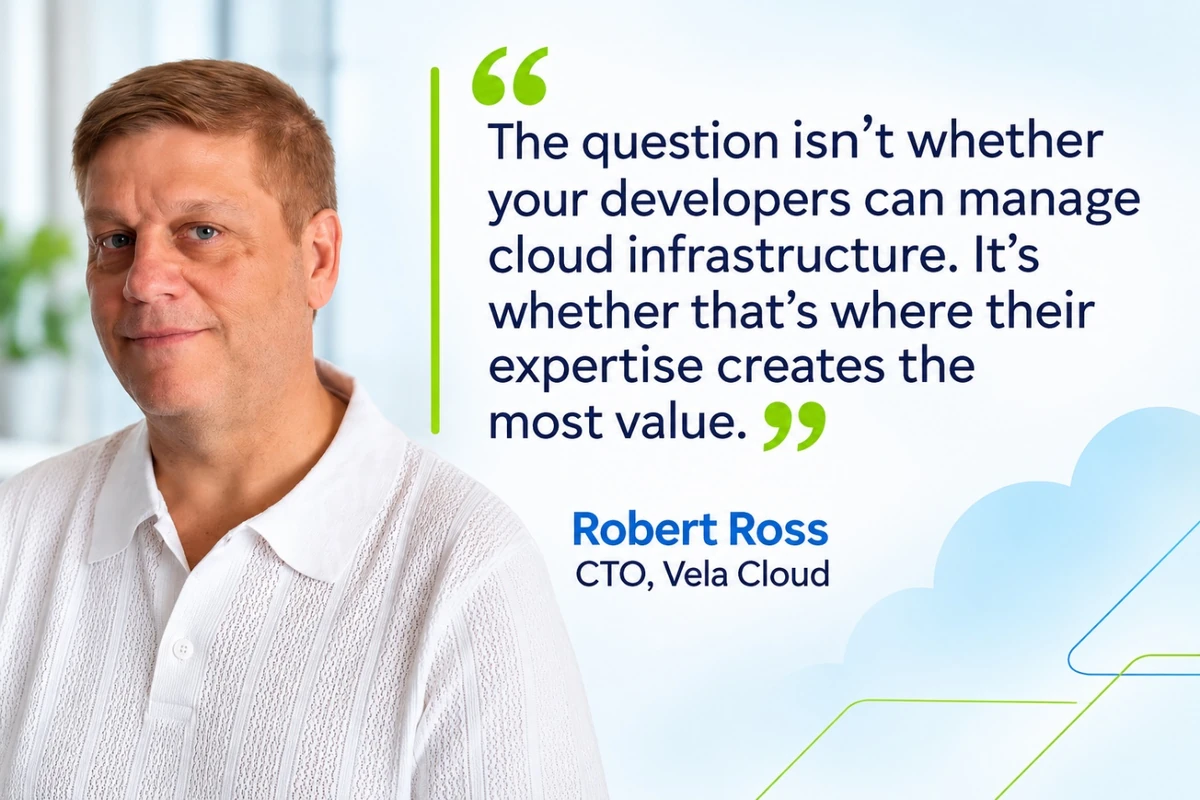
The issue isn't whether your development team can manage cloud infrastructure. It's whether that's the best use of their expertise.
After all, your customers are paying for the value your application delivers, not the time your developers spend maintaining the infrastructure behind it.
What If You Build a Dedicated Cloud Operations Team?
Hiring specialized personnel can protect your developers' time, but it introduces another challenge: finding, hiring, and managing people with the right expertise.
And that expertise isn't necessarily easy to find.
VMware by Broadcom's Private Cloud Outlook 2026, based on a survey of 1,800 senior IT decision-makers at large enterprises, found significant gaps in the skills required to manage cloud environments. The most frequently cited shortages were AI infrastructure and operations (40%), cloud and distributed security operations (38%), and Kubernetes operations (37%).
The report also found that 81% of enterprises surveyed either fully outsource or use professional services for cloud-related needs, with closing the skills gap an important reason organizations turn to external expertise.
Building an internal cloud operations capability means more than hiring technical specialists. It requires processes, operational coverage, continuity planning, and ongoing management oversight.
Who responds when your infrastructure specialist is unavailable? How do you maintain service levels as your cloud customer base grows? And who oversees it all?
That responsibility may ultimately fall to your CTO, VP of Engineering, or another senior technical leader already focused on product strategy, development priorities, and long-term technology investments.
Management attention is just as finite as development capacity.
Building cloud operations internally may make strategic sense for some ISVs. But it means establishing and managing a new operational capability, not simply adding another delivery option for your software.
In-House vs. Outsourced Cloud Hosting: What Should ISVs Consider?
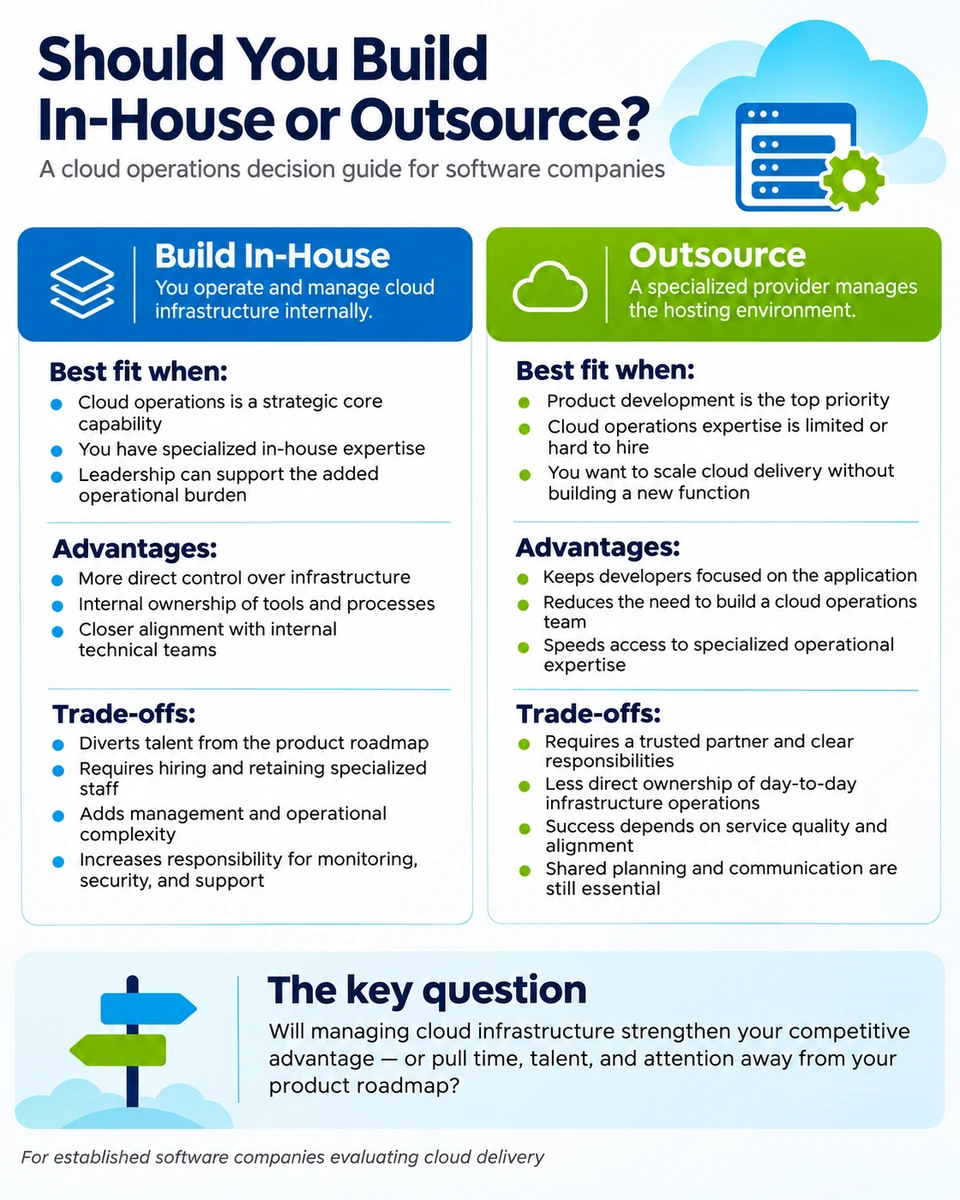
The choice between managing cloud hosting internally and outsourcing it isn't simply a question of technical capability. It's a decision about where the company wants to invest its resources.
Managing cloud infrastructure in-house offers direct control over the hosting environment, but requires dedicated expertise, operational processes, and ongoing oversight.
Outsourcing cloud infrastructure to a specialized provider can reduce those internal demands while letting the ISV focus on application development and customer relationships.
Neither approach removes the need for technical planning or accountability.
The key question is whether operating cloud infrastructure contributes to your competitive advantage or diverts resources from the software that differentiates your business.
Related reading: Self-Hosting vs. Managed Cloud Delivery
Can You Outsource Cloud Infrastructure Without Giving Up Control of Your Software?
Yes. An ISV can retain responsibility for its application, product direction, and customer relationships while relying on a specialized cloud hosting provider to manage the underlying infrastructure.
Your customers chose your application because it solves a problem. They value its functionality, reliability, familiarity, and the expertise you've built into it over time.
Offering that application through the cloud should draw upon those strengths, not divert resources from them.
Technical collaboration, integration considerations, and shared responsibilities will remain. Outsourcing infrastructure doesn't eliminate every operational concern, nor does it eliminate the need for clear agreements about security, support, and service performance.
But it can significantly reduce the need to build and manage an entirely new operational capability internally.
Your development team can remain focused on improving the application, while customers gain another way to access the software they already rely on.
Let Cloud Delivery Support Your Product Roadmap, Not Compete With It
At Vela Cloud, our approach began with a straightforward question:
How can we make it as easy as possible for an established software company to offer its application through the cloud?
That means providing cloud infrastructure and operational expertise, so ISVs don't have to build and manage the entire hosting environment themselves.
We believe software companies should be able to modernize how they deliver applications without diverting valuable resources away from developing and improving those applications.
Because the real question isn't whether your company can manage cloud infrastructure. It's whether doing so is the best use of the people, expertise, and resources that make your software business successful.
If you'd like to talk through what cloud delivery could look like without pulling your team off the roadmap, let's talk.
Thanks for reading!
Frequently Asked Questions
What are the hidden costs of managing cloud hosting in-house?
Beyond infrastructure expenses, in-house cloud hosting requires specialized technical expertise, ongoing monitoring, security management, backup and disaster recovery processes, and operational support. For an ISV, the less visible costs include development time diverted from product improvements and management resources committed to overseeing cloud operations.
When should an ISV consider outsourcing cloud infrastructure?
An ISV should consider outsourcing when managing cloud infrastructure competes with product development priorities, requires expertise the company doesn't have internally, or creates operational responsibilities that are difficult to support. The decision should consider the company's technical capabilities, customer requirements, growth plans, and the strategic value of managing infrastructure internally.
What responsibilities does an ISV retain when outsourcing cloud hosting?
An ISV typically retains responsibility for its application, product roadmap, and customer relationships. Depending on the hosting arrangement, the provider may manage infrastructure, monitoring, backups, security controls, and operational support. The parties should clearly define responsibilities for application updates, integrations, incident response, and data protection.
Sources
- VMware by Broadcom, "Private Cloud Outlook 2026: The AI Tipping Point" (published June 2026). vmware.com