
Insight
Self-Hosting vs Managed Cloud Delivery: What's the Right Model for Your Software Business?
For an established software company moving toward cloud delivery, one of the biggest decisions is not simply where the application will run. It is who will take responsibility for everything required to keep it running.
Self-hosting can absolutely make sense. Some software companies have the scale, expertise and strategic reasons to build and operate their own cloud environment.
But self-hosting isn't simply moving an application onto cloud infrastructure. It means taking responsibility for infrastructure, security, monitoring, backups, scaling, customer access, ongoing maintenance, and tech support issues that come with operating a business-critical service. That responsibility also extends to incident response and remediation when something goes wrong.
That makes the real question less about technology and more about business strategy: Do you want cloud operations to become a core competency of your software development company?
What Do We Mean by Self-hosting?
For this discussion, self-hosting means the software development company builds and operates the application while also assuming responsibility for the entire cloud environment used to deliver it. The underlying infrastructure could be owned by the software company or rented from a cloud provider such as AWS, Azure or Google Cloud. What makes the model self-hosted is the application developer retains responsibility for configuring, securing, monitoring, maintaining, scaling, backing up and supporting the entire environment, 24 hours a day.
Managed cloud delivery shifts much of that day-to-day operating responsibility to a specialized cloud partner.
When Does Self-hosting Make Sense?
There are good reasons to self-host.
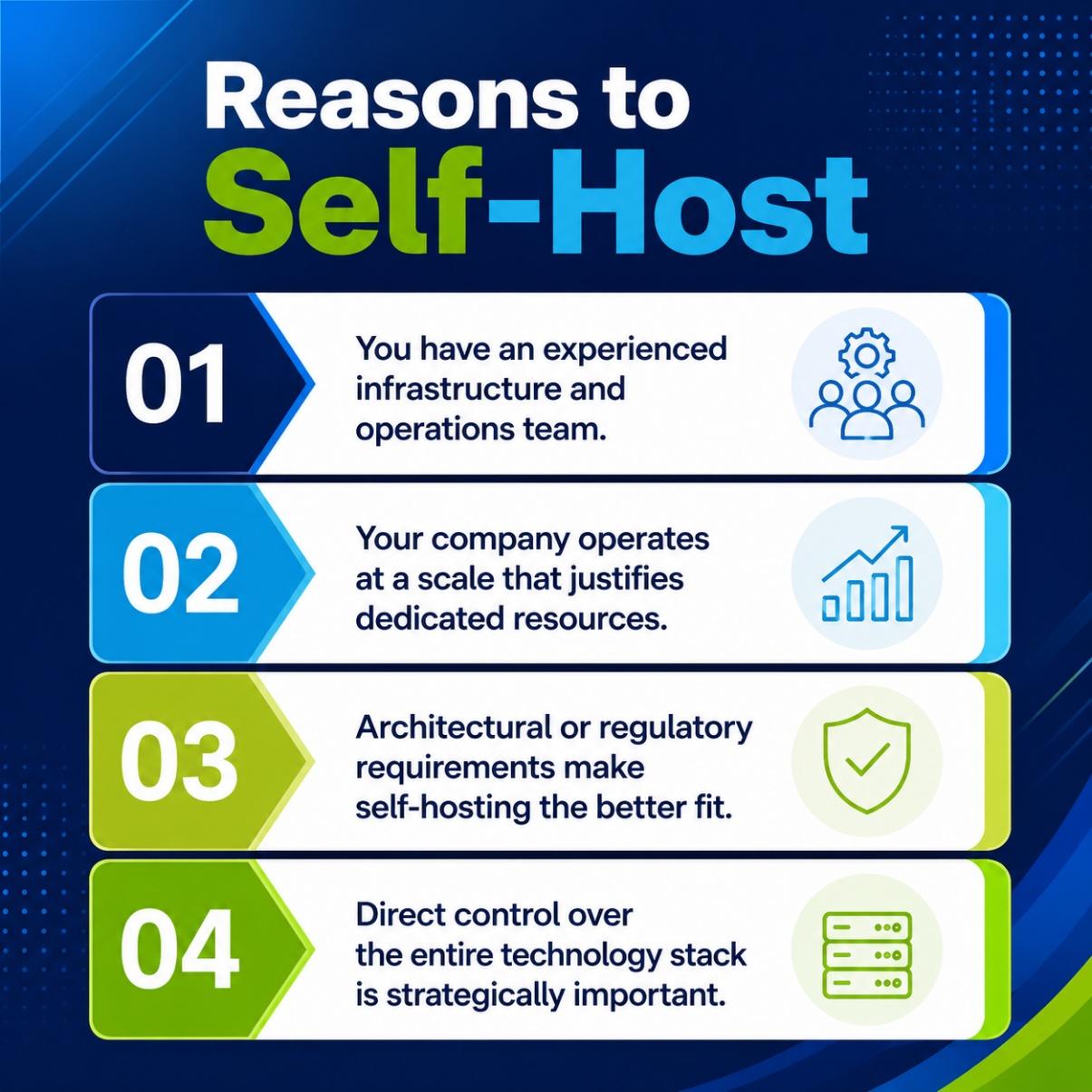
A software company may already have an experienced infrastructure and technical team. It may operate at a scale where investing in skilled personnel and robust infrastructure is economically justified. It may have unusually specific architectural or regulatory requirements or simply decide that direct control over the entire technology stack is strategically important.
In those circumstances, building cloud operations internally may be the right decision.
The mistake is assuming that self-hosting is automatically the simplest or least expensive route because the software company controls the infrastructure.
Infrastructure is just a foundation. The real cost of cloud is everything required to operate and maintain it.
What Are You Really Taking On When You Self-host?
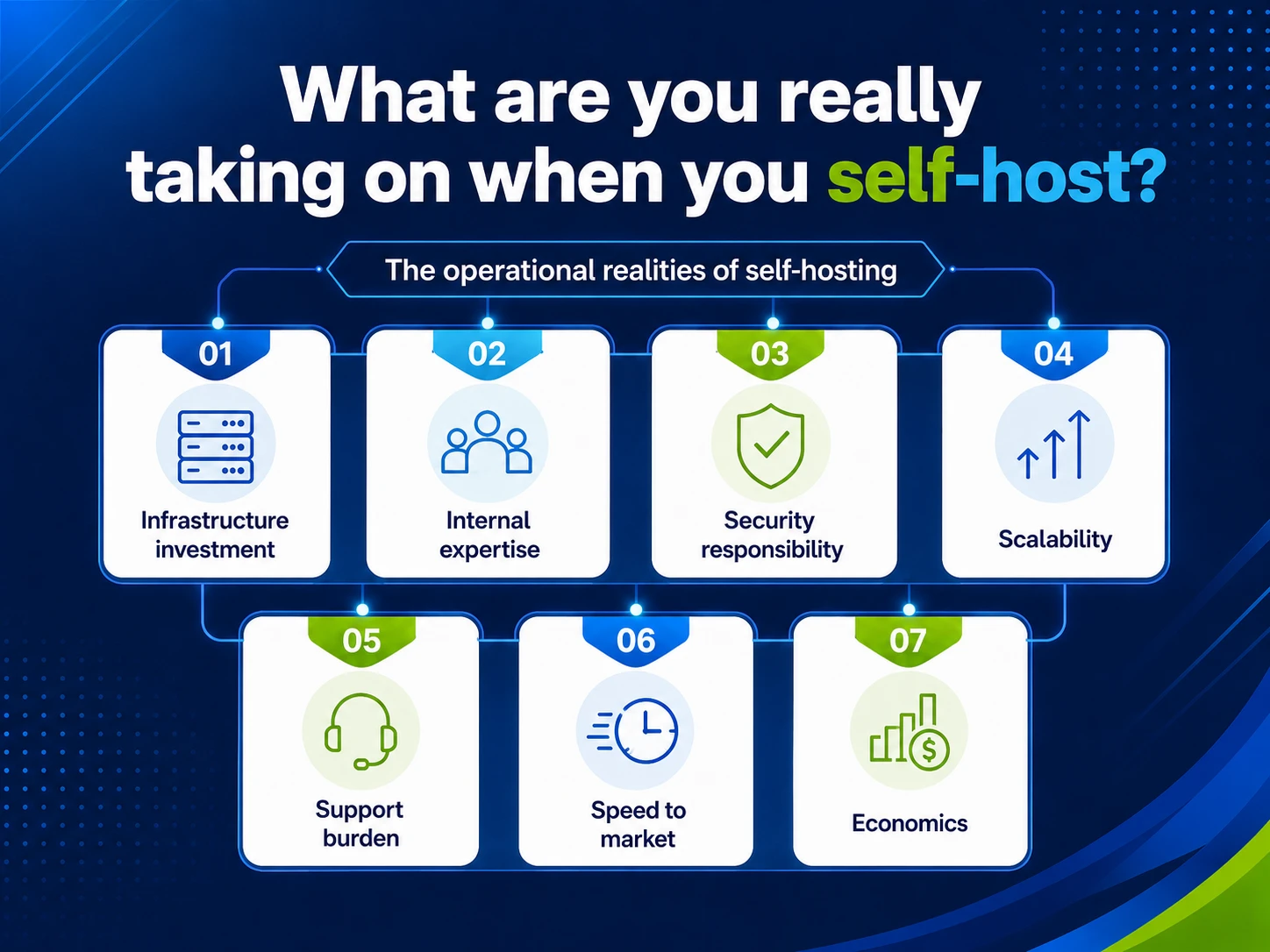
Infrastructure Investment
Acquiring infrastructure from a self-service cloud provider changes where and how infrastructure is consumed, but it does not eliminate the responsibility of operating it.
Someone still has to design the environment and the security plan, provision resources, configure access, maintain systems, manage backups, monitor performance, apply patches and respond when something goes wrong.
For a software company, the important calculation is therefore not simply the cost of compute and storage. It is the cost of building and continuously operating the environment around them.
Internal Expertise
Software development and cloud operations are related disciplines, but they are not the same discipline.
Your developers understand your application, its business logic and its roadmap. Running a production cloud environment requires additional expertise in infrastructure, networking, access management, monitoring, backup and recovery, security and operational troubleshooting.
That creates an important resource question: Will your existing team take on those responsibilities, or will you build a new capability around them?
And if your best technical people are spending time managing infrastructure, what are they not doing on the product?
Security Responsibility
Security deserves particular attention because moving infrastructure into the cloud does not automatically transfer responsibility for securing your operating environment.
Cloud providers offer powerful security tools. But those tools still need to be selected, configured, monitored and maintained appropriately.
For a self-hosted software company, that can mean responsibility for access controls, firewalls, patching, endpoint protection, monitoring, backups, incident detection and response, and the processes that surround them.
Security therefore becomes an ongoing operational responsibility rather than a box checked during migration.
Scalability
Getting the first customers into a hosted environment is one challenge. Supporting the next hundred or thousand is another.
Growth introduces questions around capacity, provisioning, performance, customer environments and resource management. What works when a hosted offering is small may become increasingly demanding as adoption grows.
That makes scalability an organizational question as much as a technical one: Can your operating model scale as efficiently as your infrastructure can?
Support Burden
Cloud delivery changes the support relationship.
When customers run software on their own local infrastructure, many server, network and access problems ultimately belong to the customer or its IT provider.
Once you deliver the application as a cloud service, customers naturally look to you when they cannot work.
The problem may have nothing to do with your application. It could involve access, connectivity, user administration, a workstation, a printer or something else in the operating environment. But to the customer, the distinction often does not matter. They bought a service from you and they need it working.
That changes the support equation: once you own the service, you own the outcome.
Speed to Market
Building your own cloud operation can take considerable time, regardless of whether you own the underlying infrastructure or consume it through a self-service cloud platform.
Infrastructure must be designed. Access processes must be established. Security and monitoring need to be implemented. Support procedures have to be created. Staff may need to be hired or trained.
For an established ISV, this matters because the objective is usually not to become excellent at hosting. It is to respond to customers who increasingly want a cloud-delivered option.
Managed cloud delivery can shorten that path considerably. At Vela Cloud, for example, we have found that most suitable applications can be operating in the cloud within weeks, with the exact timeline determined by application complexity and customer requirements.
Economics
Self-hosting can look attractive when the comparison starts and ends with infrastructure pricing.
A more useful calculation is total operating cost.
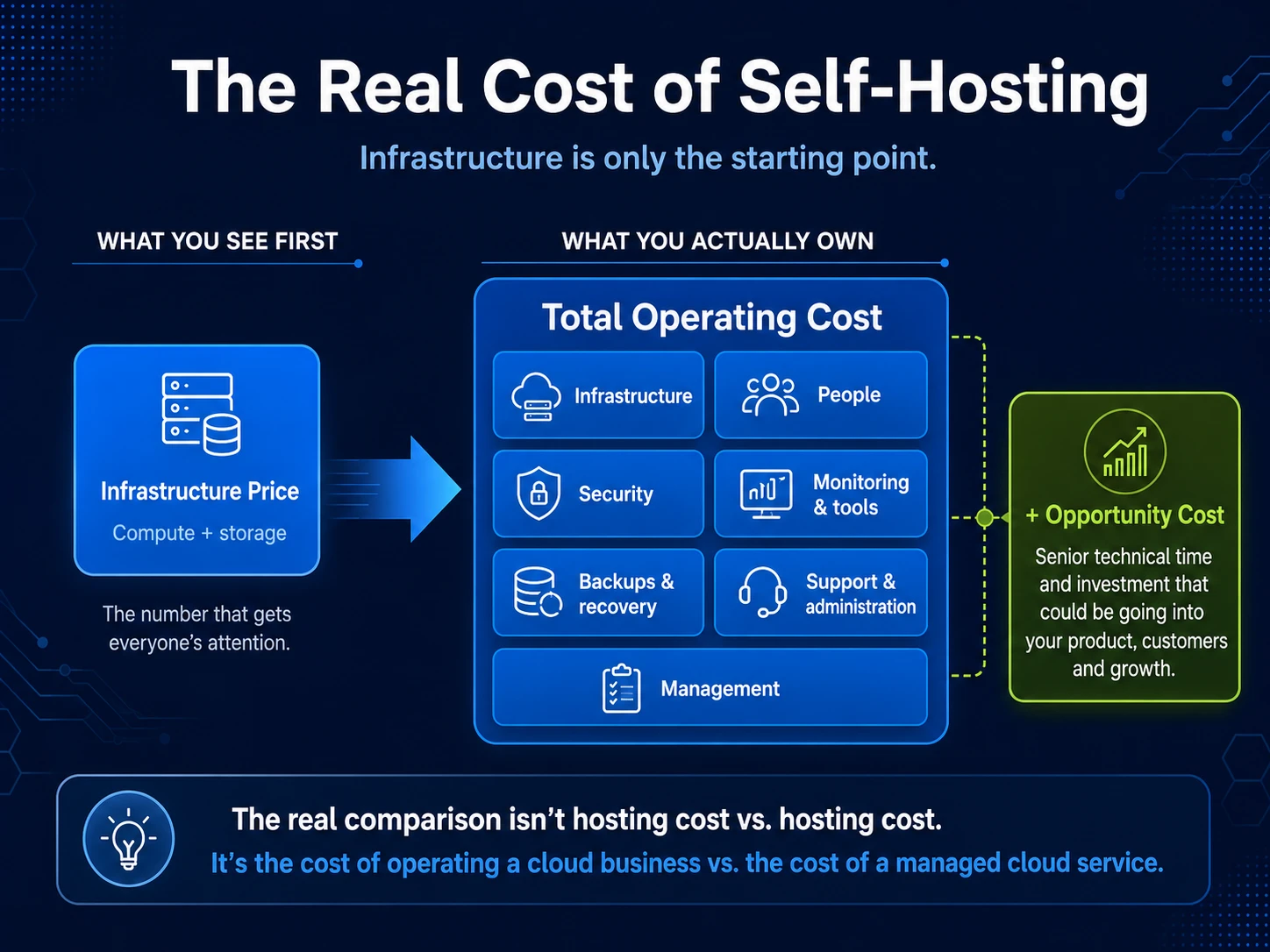
That includes infrastructure plus the people, security, monitoring, backups, tools, support, administration and management required to deliver the service reliably.
It should also include opportunity cost.
Every dollar and every senior technical hour devoted to operating cloud infrastructure is a dollar or hour that cannot be invested somewhere else.
For many ISVs, that is where managed cloud delivery changes the business case. It turns cloud operations from a capability the company has to build into a service it can incorporate into its own offering.
The point is not that one operating model is inherently better than the other.
When a resource becomes essential to competition but inconsequential to strategy, the risks it creates become more important than the advantages it provides.
— Nicholas Carr, technology strategist (2003)
That distinction is particularly important for established software companies. Your application, intellectual property, industry expertise, and customer relationships are strategic assets that differentiate your business and deserve your investment. Operating the infrastructure beneath them may be essential, but essential does not necessarily mean strategic to own.
The economic question, then, is not simply whether you can operate the infrastructure yourself for less. It is whether taking on the cost, complexity, and risk of becoming an infrastructure operator creates enough strategic value to justify it.
The Real Question: Capability or Priority?
People tend to frame cloud decisions around capability. Many established software companies are fully capable of doing it themselves. The more valuable executive question, however, is: Is this where we want to build our next capability?
If your competitive advantage comes from specialized software, decades of embedded business logic, deep vertical-market knowledge and strong customer relationships, operating cloud infrastructure may add relatively little to what differentiates your company.
That is the strategic argument for managed cloud delivery.
You continue to own the application. You control the roadmap, pricing, brand and customer relationship. But the operational cloud layer becomes somebody else's responsibility. That principle is central to the Vela Cloud model and has shaped the offering around what our clients have told us they actually need.
Managed Cloud Delivery is More Than Hosting
This distinction is important.
Managed cloud delivery should not simply mean renting somebody else's server.
A genuine managed model takes responsibility for the operating layer around the software: infrastructure, monitoring, backups, security, administration, scaling and support.
That is particularly relevant for established Windows software companies. They may already have a proven application, loyal customers and years of product development behind them. Their challenge is not building better software. It is finding a better way to deliver the software they have already built.
So Which Model is Right for Your Software Business?
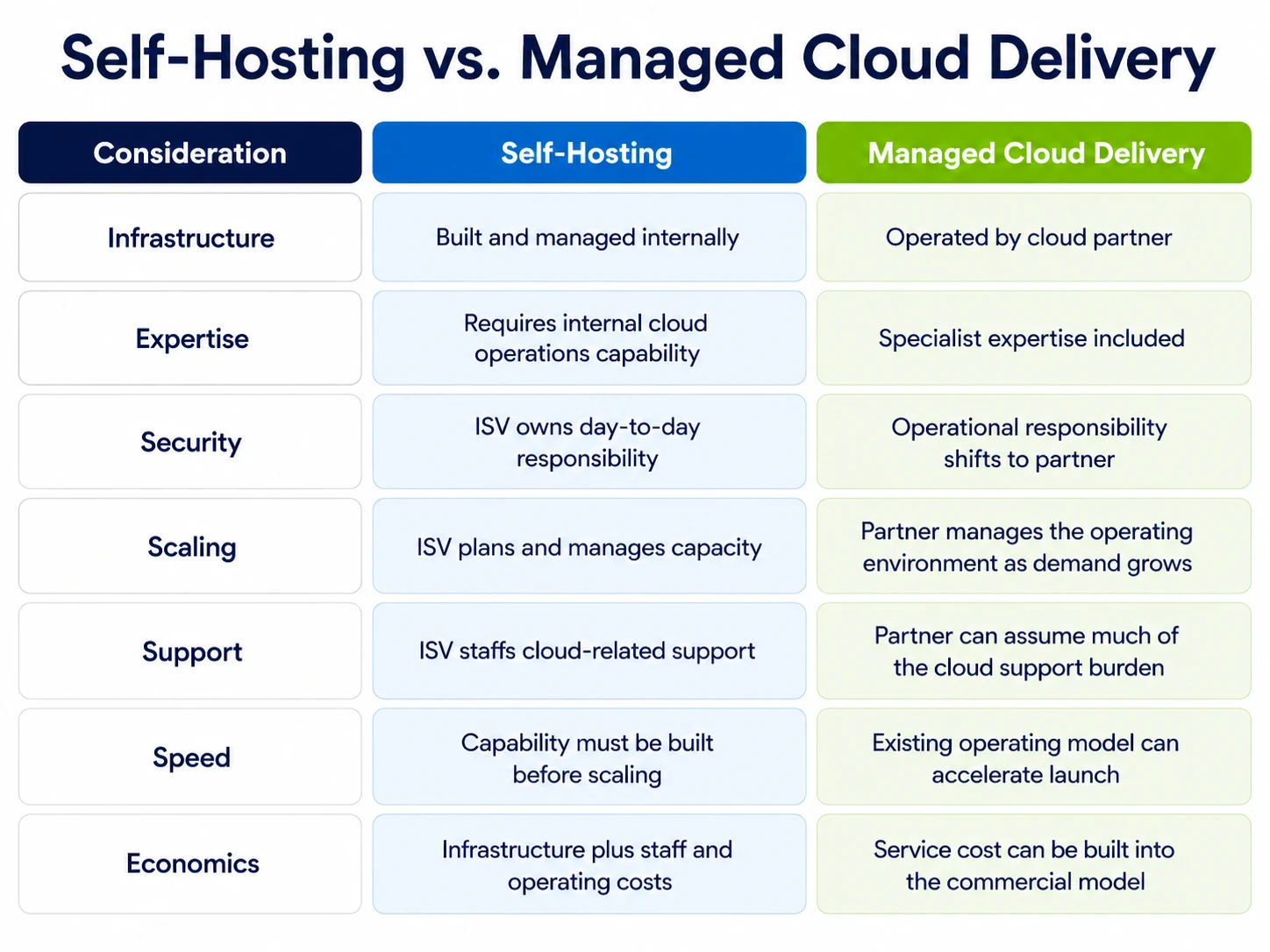
Self-hosting may be the right choice if cloud infrastructure and operations are capabilities you deliberately want to own, staff and develop over the long term.
Managed cloud delivery may make more sense if your priority is to offer customers a professionally operated cloud service that can scale and be ready in a short period of time while keeping your people and capital focused on the software business.
Neither decision should begin with the server.
It should start with the business you want to run five years from now.
For established software companies, that may be the most important cloud question of all.
Frequently Asked Questions
What is the difference between self-hosting and managed cloud delivery?
With self-hosting, the software company operates the cloud environment itself, including infrastructure, security, monitoring, backups, scaling and support. With managed cloud delivery, a specialist partner operates that cloud layer on the software company's behalf.
Is self-hosting cheaper than managed cloud delivery?
Not necessarily. Infrastructure pricing is only one part of the cost. Software companies should also account for cloud expertise, security, monitoring, support, administration, tools and the opportunity cost of using internal technical resources.
Does moving a Windows application to the cloud require rewriting it as SaaS?
No. Established Windows client/server software can be delivered as a browser-based or native application through a professionally managed cloud environment without being rebuilt as browser-native SaaS. Vela Cloud is specifically designed around that model.