
Insight
Cloud Delivery Is a Business Decision, Not Just a Technology Decision
In our earlier look at Self-Hosting vs Managed Cloud Delivery: What's the Right Model for Your Software Business?, we concluded that the decision should begin with the business you want to run five years from now.
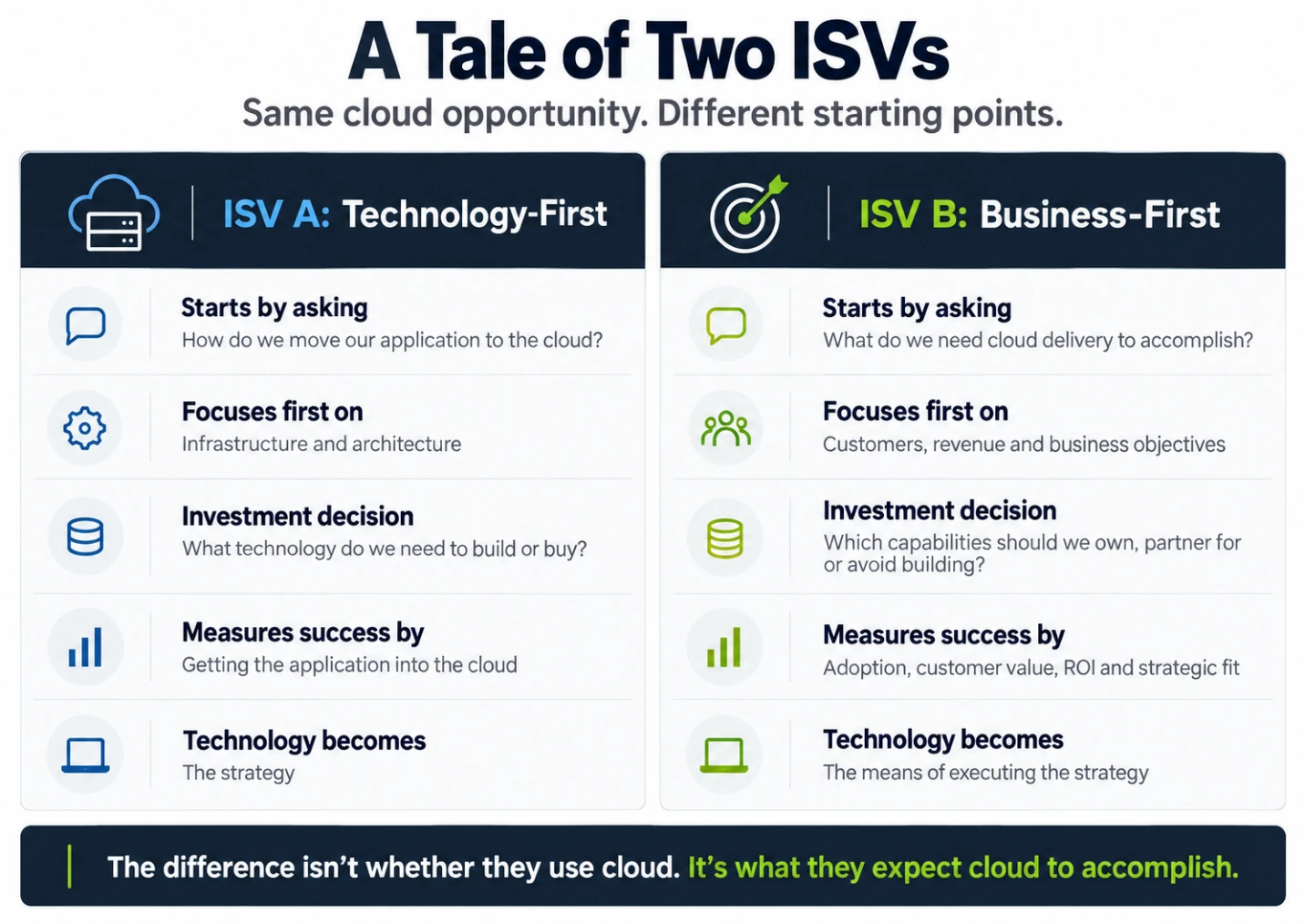
That raises a bigger question. What should software leaders consider when making cloud delivery part of business strategy? Two software companies can make similar technology decisions and end up with very different businesses.
One may create a new recurring revenue stream, make its software easier for customers to adopt, and keep its development team focused on the product.
Another may decide to bring cloud operations in-house, taking on infrastructure management, support obligations, security responsibilities, and additional operating costs.
The technology may be similar. The business decisions behind it are not.
A cloud delivery strategy affects far more than where an application runs. It can influence how the company makes money, how customers want to buy and use its software, where it invests resources, which responsibilities the business chooses to own, and how the product competes over time.
That is why cloud strategy belongs in the executive conversation.
From our point of view, the commercial rationale should come first. Infrastructure is how it gets done.
That premise also shows up in the broader cloud conversation. Gartner's Cloud Strategy Assessment Checklist for CIOs makes the distinction explicit: cloud strategy should be driven by business strategy and aligned with business goals.
What Is a Cloud Delivery Strategy?
A cloud delivery strategy is the business and operating model a software company uses to make its application available as a cloud service.
It includes technology, but it also answers larger questions. What will customers buy? How will the offering generate revenue? What capabilities should the company build itself? Which responsibilities should stay in-house? How does cloud delivery fit with the product roadmap? And where should the business invest its people and capital?
Those decisions matter because moving infrastructure does not guarantee business value.
In its article "Unlocking Cloud Value: Achieving Operational Excellence Through SRE," McKinsey underscores the gap between adopting cloud and creating value from it. The firm reported that only 10% of cloud transformations achieve their full value, noting that simply transferring existing operating models to the cloud can limit value creation or even destroy it.
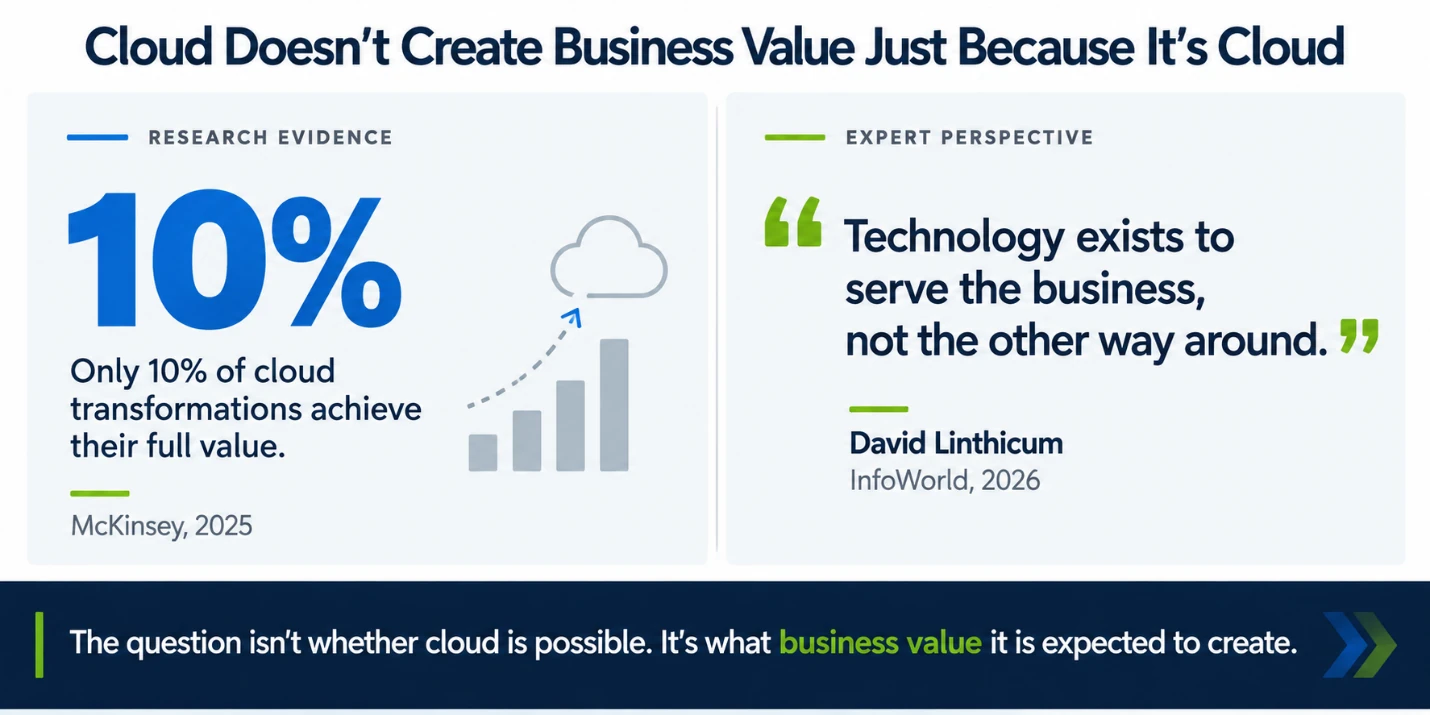
The lesson for an established software company is clear. Start with the business outcome. Then choose the operating model and technology that support it.
The Six Business Questions Behind a Cloud Strategy
Before deciding how to deliver an application through the cloud, software leaders should examine six areas.
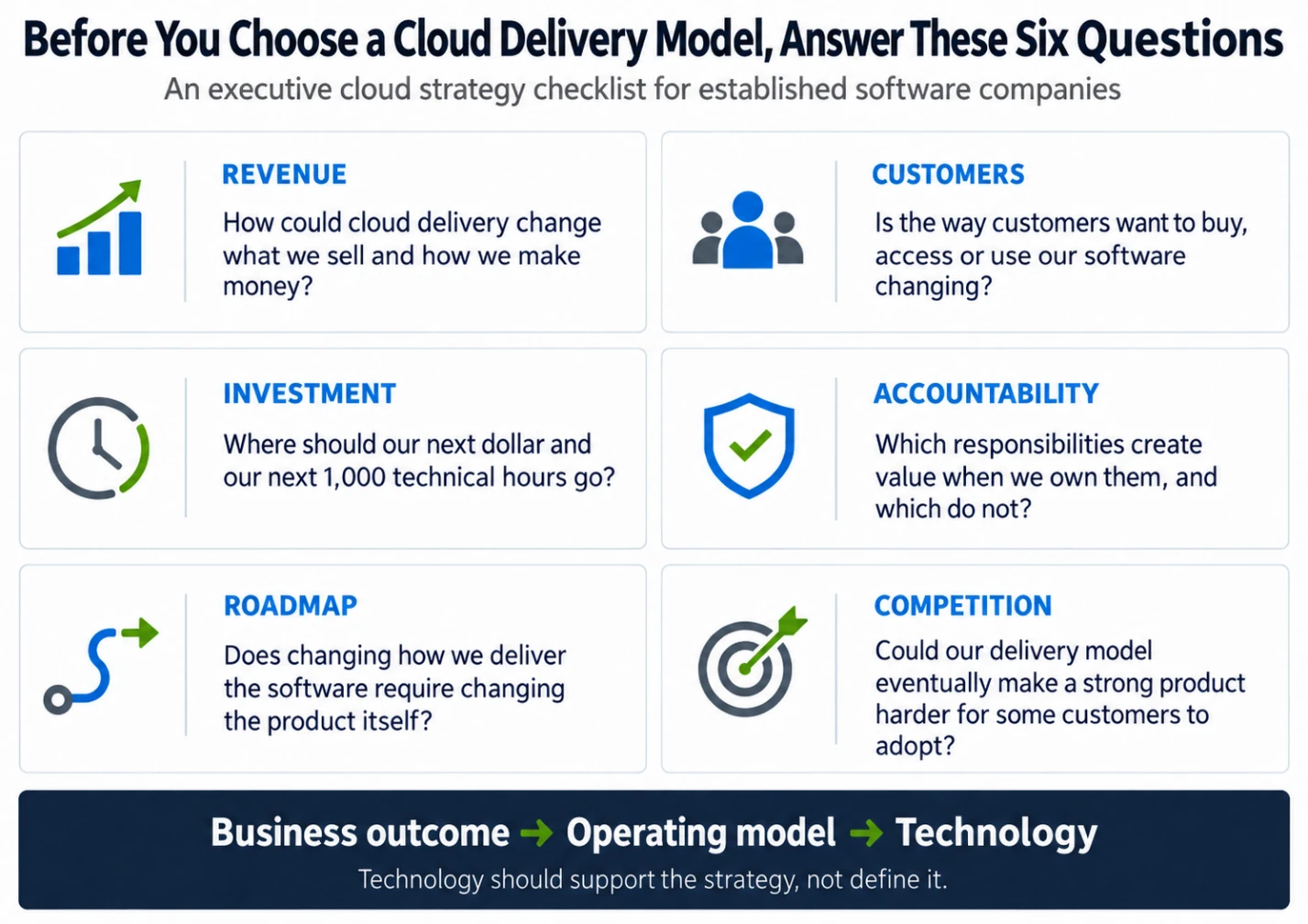
1. Revenue: How Could Cloud Delivery Change the Economics of the Business?
Cloud delivery can alter more than the technology cost structure. It can change what the company sells.
An ISV that historically earns revenue from software licensing, maintenance, or support may be able to add an ongoing cloud service alongside its existing model. That creates questions around pricing, packaging, margins, adoption, and recurring revenue. It also calls for a wider calculation of value.
That business-first approach is increasingly important as companies reassess what they are getting from technology investment.
David Linthicum, longtime cloud strategist, author, and former technology CEO, argues in his InfoWorld article "Why Digital Transformations Still Fail" that many have failed to deliver their expected ROI because organizations focused on technology rather than the business problems they were trying to solve. His conclusion: "Technology exists to serve the business, not the other way around."
For software companies considering cloud delivery, the same discipline applies. The question is not whether cloud technology is available or technically feasible. It is whether changing the delivery model creates enough business value to justify the investment, responsibility, and organizational change involved.
Roger Hoss, CEO of Vela Cloud, makes a similar distinction. "Cloud delivery is a mechanism. The outcome is a software business with more reach, more predictable revenue and less operational weight."
His larger point is worth emphasizing. The business case is not simply about putting software somewhere else. It is about what the company can gain by changing how it delivers that software.
2. Customers: Is the Way Customers Buy and Use Software Changing?
A cloud strategy should also consider how customer expectations are evolving. Customers may value the functionality of an established application as much as ever, while expecting less responsibility for installing, maintaining, and supporting the technology required to use it.
For some prospects, ease of deployment may influence the buying decision. Others may want access from multiple locations, fewer infrastructure requirements, or a more predictable service model. Existing customers may simply want another way to consume software they already value.
These expectations will vary by market. That's why software companies should ask questions instead of assuming answers.
Are customers asking for a hosted option? Is infrastructure becoming an obstacle during the sales process? Are customers increasingly looking to vendors to simplify deployment? Would another delivery option make the application easier for certain segments to adopt?
3. Investment: Where Should the Business Put Its Next Dollar and Its Next 1,000 Hours?
Every software business has finite resources. Even if you can build a particular capability, does it represent the best use of capital, technical talent, and leadership attention? An established ISV may have several competing investment priorities: new product functionality, integrations, AI capabilities, sales and marketing, customer experience, technical debt, security, cloud operations, or an eventual SaaS redevelopment. All may have merit, but they cannot all be the highest priority at the same time.
That makes cloud strategy a capital-allocation decision as well as a technical one.
If a company's competitive advantage comes from specialized software, industry knowledge, customer relationships, integrations, and years of embedded business logic, where will the next dollar create the greatest return?
Building cloud capabilities may be strategically important enough to justify those resources.
4. Accountability: Which Responsibilities Should the Business Own?
Every cloud delivery model assigns responsibility somewhere. Security, availability, access, support, recovery, and ongoing operations do not disappear simply because infrastructure moves to the cloud. Leadership therefore needs clarity about who is accountable for what.
Some software companies may deliberately choose to own most of those responsibilities because cloud operations are an important capability they want in-house.
Others may decide their strategic value lies elsewhere and choose partners to take responsibility for parts of the operating environment.
Neither approach is inherently better. The important issue is whether the allocation of responsibility is deliberate, understood, and aligned with the company's capabilities and priorities.
5. Roadmap: Does Changing Delivery Require Changing the Product?
Cloud discussions can become tangled with another issue: software as a service (SaaS). They are not the same decision. A company may ultimately decide that rebuilding its application as browser-native SaaS is essential to its future. If so, the investment may be well justified.
But a full redevelopment consumes capital, technical resources and time. It also competes with features, integrations and improvements required by the existing customer base. Software leaders therefore need to answer two separate questions: How should we deliver the application? And how should we evolve the application itself?
For some, cloud delivery can modernize access while the underlying product continues to evolve. For others, cloud delivery can bridge a longer transformation. And in other cases, redevelopment may clearly be the right strategic investment.
The key is to avoid letting the delivery method dictate the product roadmap by default.
6. Competition: Could the Delivery Model Become a Competitive Disadvantage?
A mature application does not lose its value simply because the market becomes more cloud-oriented. Years of specialized workflows, industry knowledge, integrations, and product development can be extremely difficult for a newer competitor to replicate.
But customer expectations around how software is deployed, accessed, and supported keep evolving.
That creates a different strategic question for established ISVs. Could the way a strong product is delivered eventually make it less attractive, or harder for some customers to adopt?
Consider cloud delivery through a competitive lens. Are customers beginning to ask for a hosted or cloud-delivered option? Are prospects trying to reduce the infrastructure they manage themselves? Are competitors removing some of that burden from their customers? Could offering another delivery option help retain existing customers or reach prospects who would otherwise hesitate?
Those questions matter because delivery can become part of the overall customer proposition. Make sure the way the software is delivered supports, rather than constrains, the product's value.
There Is No Single Right Cloud Model
Answering these six questions will not lead every software company to the same conclusion. For one ISV, building and operating its own cloud environment may make sense because those capabilities are strategically important and the company has the expertise and scale to support them.
Another may decide its future depends on rebuilding the application as browser-native SaaS and invest accordingly.
Yet another may determine that its existing application still serves customers extremely well, but customers need a different way to access it. A managed cloud provider may be a better fit.
Hybrid approaches also exist between those models.
None is inherently more modern or more strategic than the others. A cloud strategy should not simply be a declaration that "we are moving to the cloud."
It should explain: Why? For whom? To achieve what? At what cost? With which responsibilities? And with what effect on the rest of the business?
Only then does the technology decision become clear.
For software company executives, the most useful cloud discussion may therefore have very little to do with servers.
Technology determines how a cloud strategy is executed. Leadership determines what that strategy should achieve.
Frequently Asked Questions
Why is cloud delivery a business decision?
Cloud delivery can affect revenue, customer adoption, investment priorities, operational accountability, product strategy and competitive positioning. Evaluate those business implications before deciding how the underlying infrastructure will operate.
What should a software company consider when developing a cloud strategy?
Software leaders should consider six areas: revenue, changing customer expectations, resource allocation, accountability, product roadmap and long-term competitive position.
Does moving an application to the cloud require a SaaS rewrite?
Not necessarily. Cloud delivery and SaaS redevelopment are separate strategic decisions. Depending on the application and operating model, an ISV may deliver existing software through a cloud environment without first rebuilding it as browser-native SaaS.
Should an ISV build its own cloud operation or use a managed cloud provider?
There is no universal answer. Building cloud capabilities internally can make sense when the company deliberately wants those capabilities to become part of its business. Managed cloud delivery can make sense when the company wants to offer cloud delivery while concentrating more of its own resources on the application, customers and other strategic priorities.
Can cloud delivery create recurring revenue for software companies?
It can. An ISV may be able to package cloud delivery as an ongoing service alongside its existing software licensing or subscription model. The size of the opportunity depends on pricing, customer demand, adoption, operating cost and how the offering is structured.