
Insight
What Do Your Customers Really Mean When They Ask for Cloud?
The question "Do you have a cloud version?" can trigger an enormous strategic discussion.
It is easy for an ISV to hear that question and jump immediately to a technology response. Do we need to rebuild the application? Host the existing application in the cloud? Rebuild it as SaaS?
Before making any assumptions, step back and clarify what your customer actually means.
Most software customers are not cloud architects. When they ask whether an application is available "in the cloud," they may not have a particular architecture or delivery model in mind. They may simply be asking for a change in how they access, use, or manage the software.
They may want easier access, less software to install, fewer infrastructure responsibilities, more predictable support, or simply a more convenient way to continue using an application they already value.
Perhaps employees need to work from multiple locations. Perhaps IT no longer wants to maintain the infrastructure surrounding the application. Maybe deployment has become cumbersome as the organization has grown. Or perhaps customers are comparing the experience of using your application with newer software they use elsewhere and wondering why access feels more complicated.
Understanding the need behind the word "cloud" can tell an ISV much more than the word itself.
That does not mean dismissing the request. In many cases, those changing expectations may indeed point toward a cloud-delivered version of the software.
But they don't necessarily point to the same technical approach.
Understanding what customers actually want to change should come first. How best to deliver it comes next.
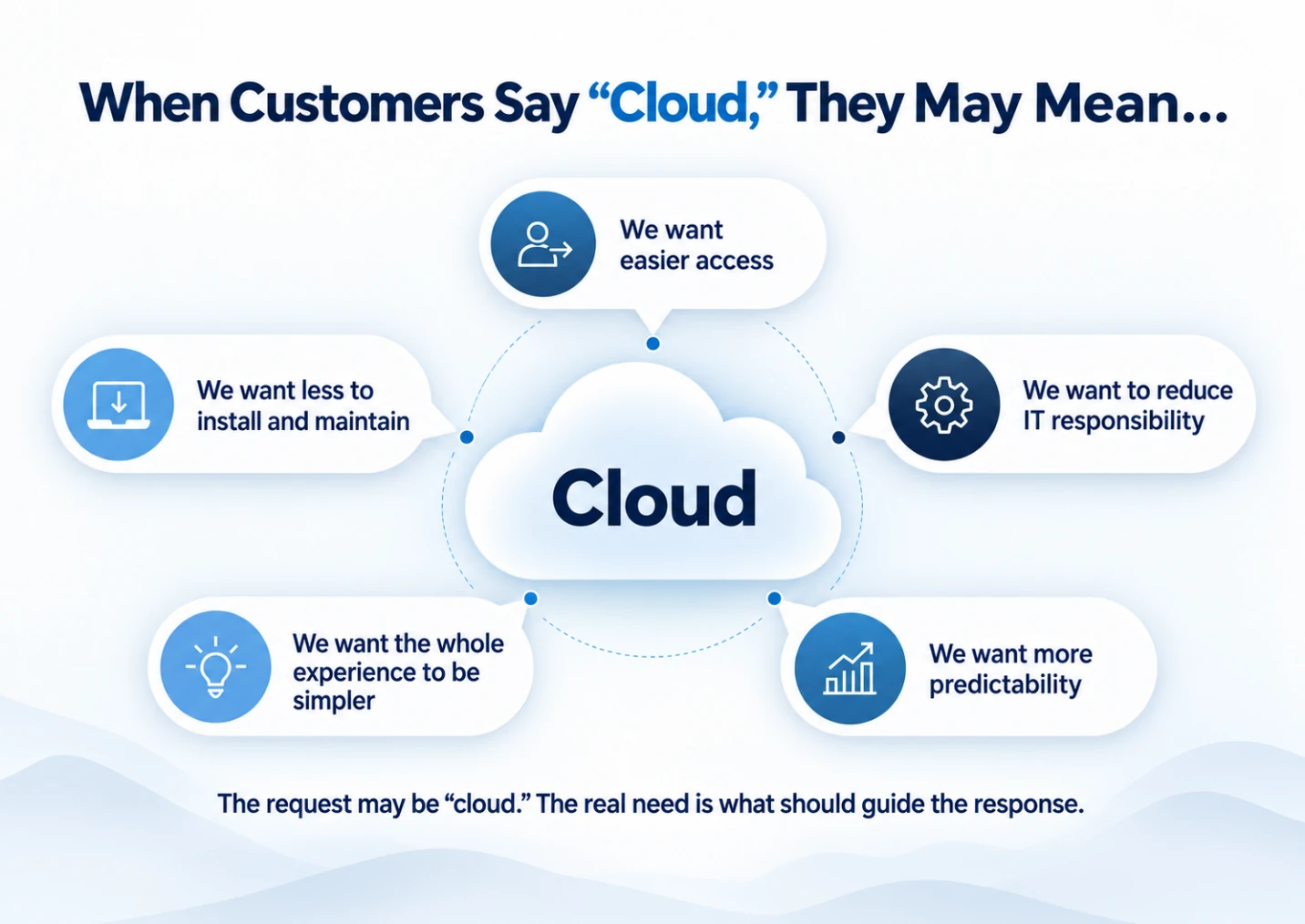
Five Examples of What Your Customer Might Actually Be Asking For
1. "We Want Easier Access."
The way people work has changed. Employees may work from different offices, from home, on the road, or across multiple locations.
Customers accustomed to that flexibility may find being tied to a particular workstation, server, or corporate network increasingly restrictive.
Their goal is to reach the software more easily.
2. "We Want Less to Install and Maintain."
Customers may have to install an application on multiple computers, maintain supporting software, coordinate upgrades, or deal with differences between local environments.
Some may simply want less software to install, update, and maintain.
As people get used to other cloud-based applications that require little local setup, traditional deployment requirements can feel more noticeable.
3. "We Want to Reduce IT Responsibility."
For some customers, the issue sits behind the application.
They may not want to manage the servers, backups, access controls, infrastructure, or other technology required to keep the software available.
They are looking to reduce the IT responsibility that comes with using it.
4. "We Want the Whole Experience to Be Simpler."
The complete customer experience increasingly influences how software is perceived.
That includes how customers access it, how new users are added, what happens when something stops working, who they contact for help, and how many different pieces must come together to keep it running.
An established application can keep performing an important business function while the surrounding experience starts to feel more complicated than customers would like.
Your customer may really be asking for simplicity.
5. "We Want More Predictability."
Customers may also be trying to reduce uncertainty.
Traditional software environments can involve multiple costs, vendors, and responsibilities: software licensing, hardware, IT resources, maintenance, backups, security, and technical support.
They may want a clearer picture of what something will cost, what is included, and who is responsible when help is needed.
They want an easier, more predictable way to budget, support, and manage their investment.
Cloud May Be the Word. The Customer Need Is the Strategy.
Software companies understandably spend a great deal of time thinking about product roadmaps and technology.
But when customers begin asking for cloud, some of the most valuable information may come from slowing the conversation down.
Ask why.
Rob Ross, Vela Cloud CTO, puts it this way: "When an ISV tells us its customers are asking for cloud, we start by understanding what those customers are struggling with. Once that's clear, you can have a much better conversation about how the software should be delivered."
For many ISVs, the response may well be to provide a cloud-delivered version of the application. But understanding the need first helps determine what that version should look like and how to deliver it.
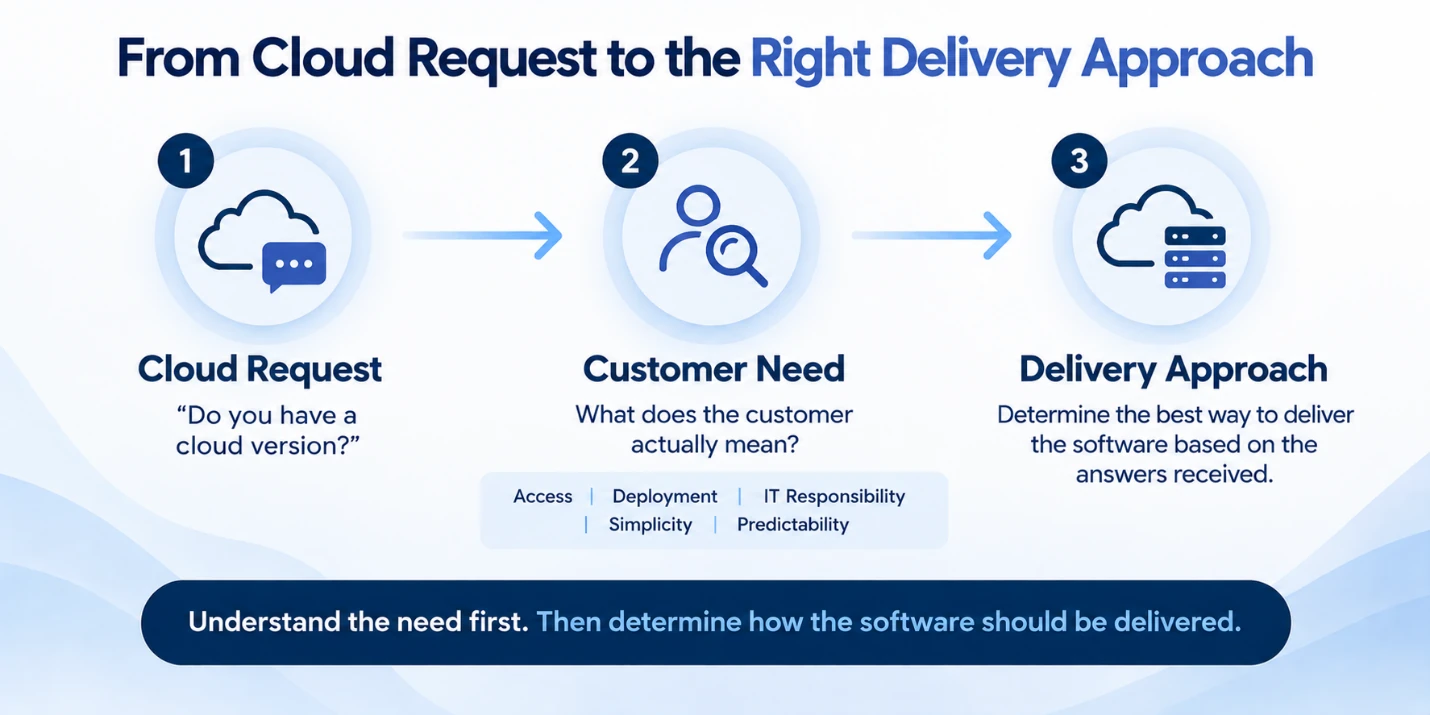
Cloud may be the request.
Understanding what customers hope will change is what helps determine the right way to deliver it.
Not Sure What Your Customers Are Really Asking For?
If your customers are asking for cloud and you are weighing what that means for your application, Vela Cloud can help you think through the delivery options.
We work with established software companies to help bring proven applications to the cloud without assuming that a full SaaS rewrite is the only path forward.
Talk to a member of our team about what your customers are asking for and what the right cloud delivery model could look like for your software.
Frequently Asked Questions
What do customers mean when they ask for cloud software?
It varies. Customers may want easier access, simpler deployment, less infrastructure to manage, more predictable support, or greater flexibility in how they use an existing application. Understanding what they expect cloud delivery to change can help determine the right response.
Does a request for cloud mean customers want new software?
Not necessarily. Customers may still value the application's functionality but want a different way to access, deploy, support, or manage it. In some cases, a better alternative may meet their needs.
Why should an ISV ask customers what they mean by cloud?
Because the word can represent several different needs. Understanding the underlying problem helps the software company determine what customers expect from a cloud version and which delivery approach is most appropriate.
Does moving an established application to the cloud require a full software rewrite?
Not necessarily. Rebuilding an application as SaaS is one approach, but it is not the only way to deliver in the cloud.
Are cloud delivery and SaaS the same thing?
No. SaaS is a software and delivery model. Cloud delivery can take different forms, and the right approach depends on the application, the ISV's business objectives, and what customers actually need.